.avif)

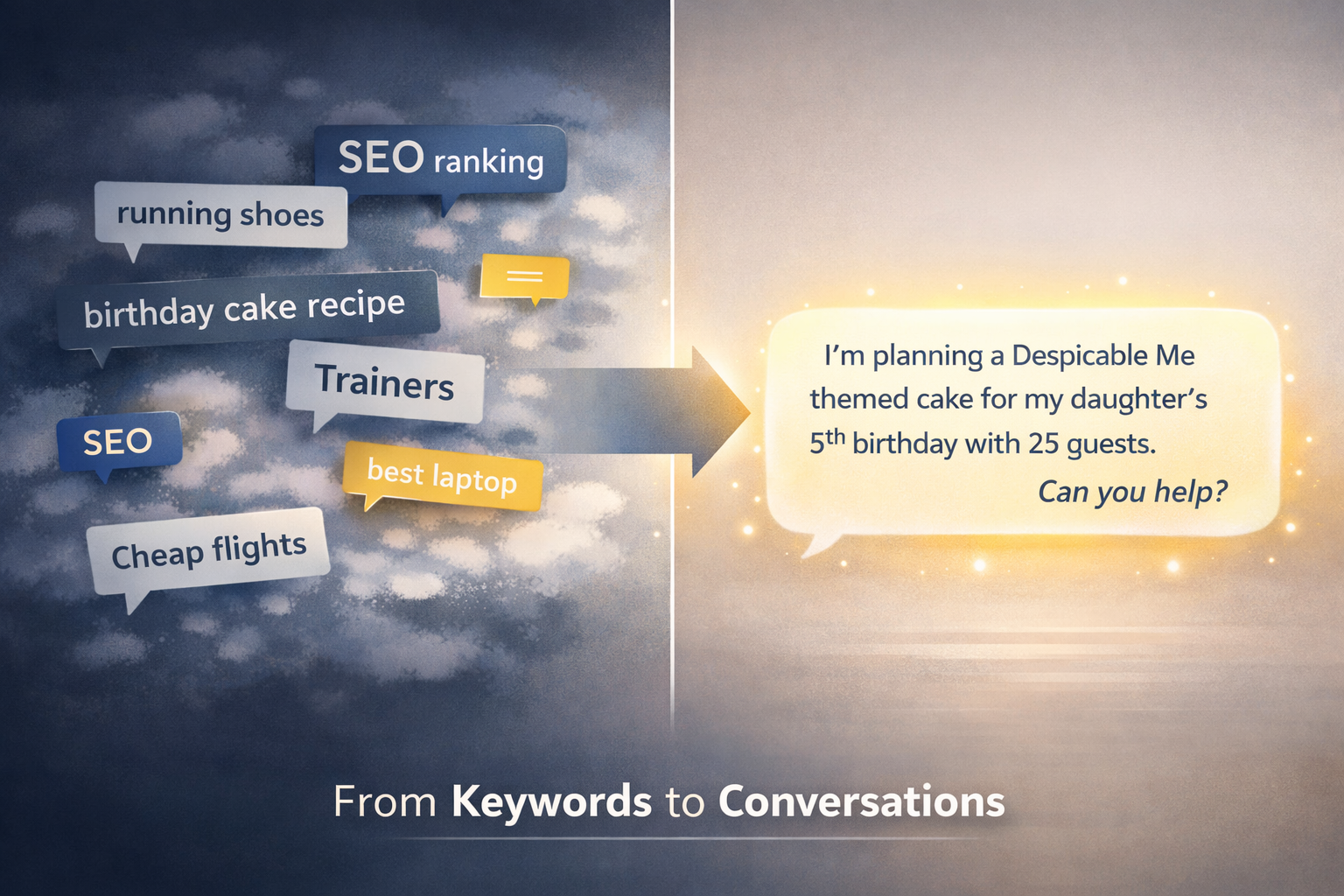
Your audience won’t be searching in keywords in 2026. So why are you still measuring success by them?
Ok, I know it’s a strong statement - so let me clarify…
When I say ‘keywords’ - I’m referring to those short tail, super high search volume keywords (you know, the ones we have historically focussed on trying to win?) For informational queries they could look like ‘birthday cake recipe’ and for commercial it could be ‘running shoes’.
Optimising and ranking for these has always been the main goal for SEO teams, but now I sit in front of you (virtually) telling you not to optimise for them anymore, sounds crazy right?
Well, let me explain why it’s not: The landscape has completely changed - across both platform changes and user behaviour.
No, this isn’t me telling you SEO is dead (for the 1000th time) but I am reminding you of what you already know - Search has changed, and I’m here to tell you what to do about it
What’s changed?
1. The SERP isn’t what it used to be
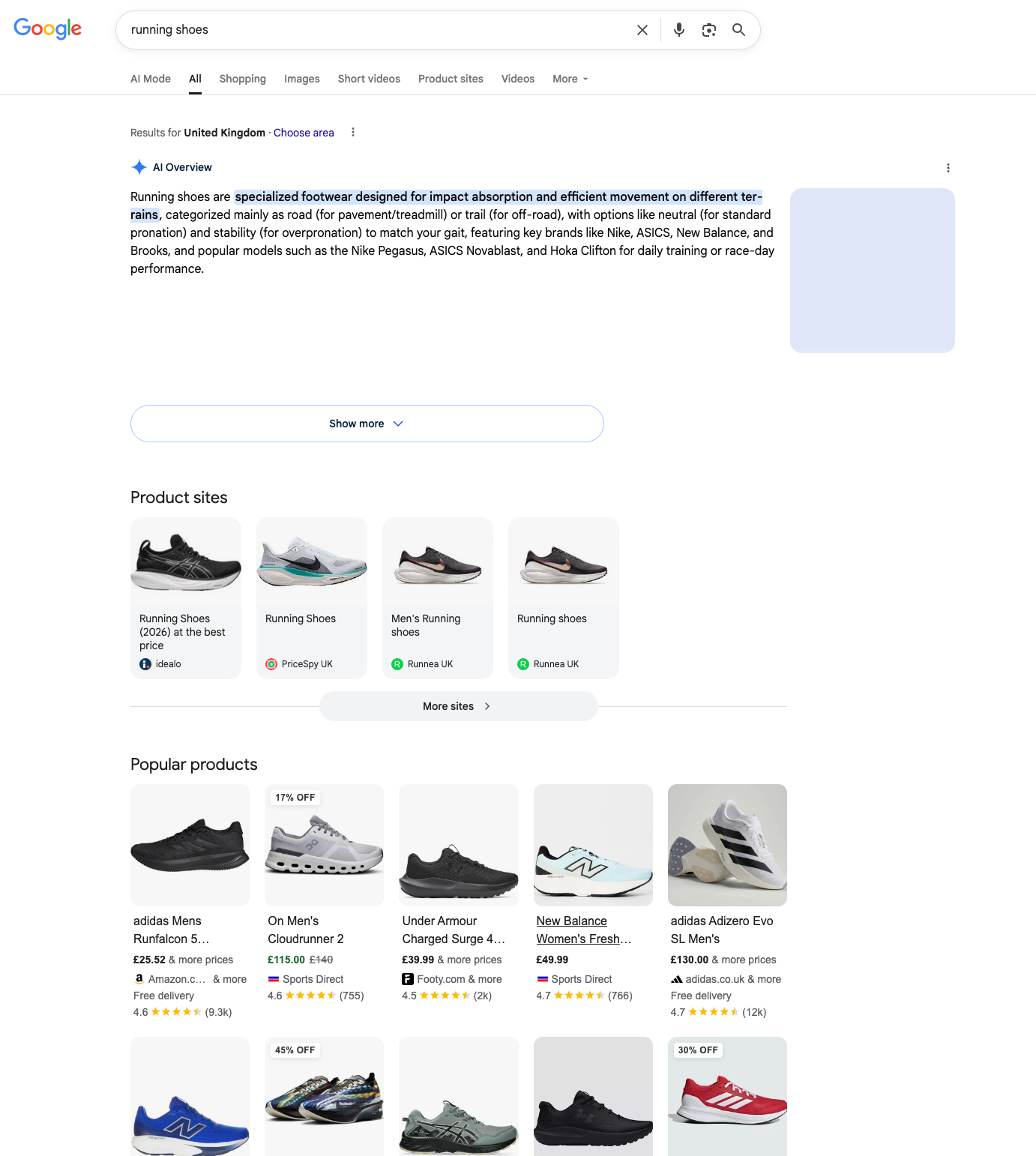
For starters, the Google SERP isn’t what it once was. We’re now in a zero-click reality where organic blue links are competing against heaps of SERP features, and AI overviews that give the users everything they need without ever having to visit your site.
You could be in position 1 on the SERPS yet effectively invisible, due to being consistently below the fold (especially on mobile search experiences) - meaning it would have little to no commercial impact.
We analysed thousands of non-brand keywords across two major retail brands, John Lewis and Sephora, to understand how frequently Google inserts SERP features into the results. We found that For:
John Lewis: 82% of non-brand keywords trigger at least one SERP feature
Sephora: 91% of non-brand keywords trigger at least one SERP feature
This means in almost every case, a SERP feature is present within the keyword landscape of these brands.
What’s more, it’s the TYPE of SERP features we are seeing that reflect both the changing landscape and the type of information sought from users.
For John Lewis’s keyword landscape: 16% of the searches trigger a video snippet, 15% trigger popular products and 9% trigger PAA. While 4% trigger a discussions and forums feature and 3% trigger AIO.
For Sephora’s keyword landscape: 13% trigger video snippets, 11% trigger images, and 9% trigger PAA. While 8% trigger discussions and forums and 6% an AIO.
2. User behaviour is changing
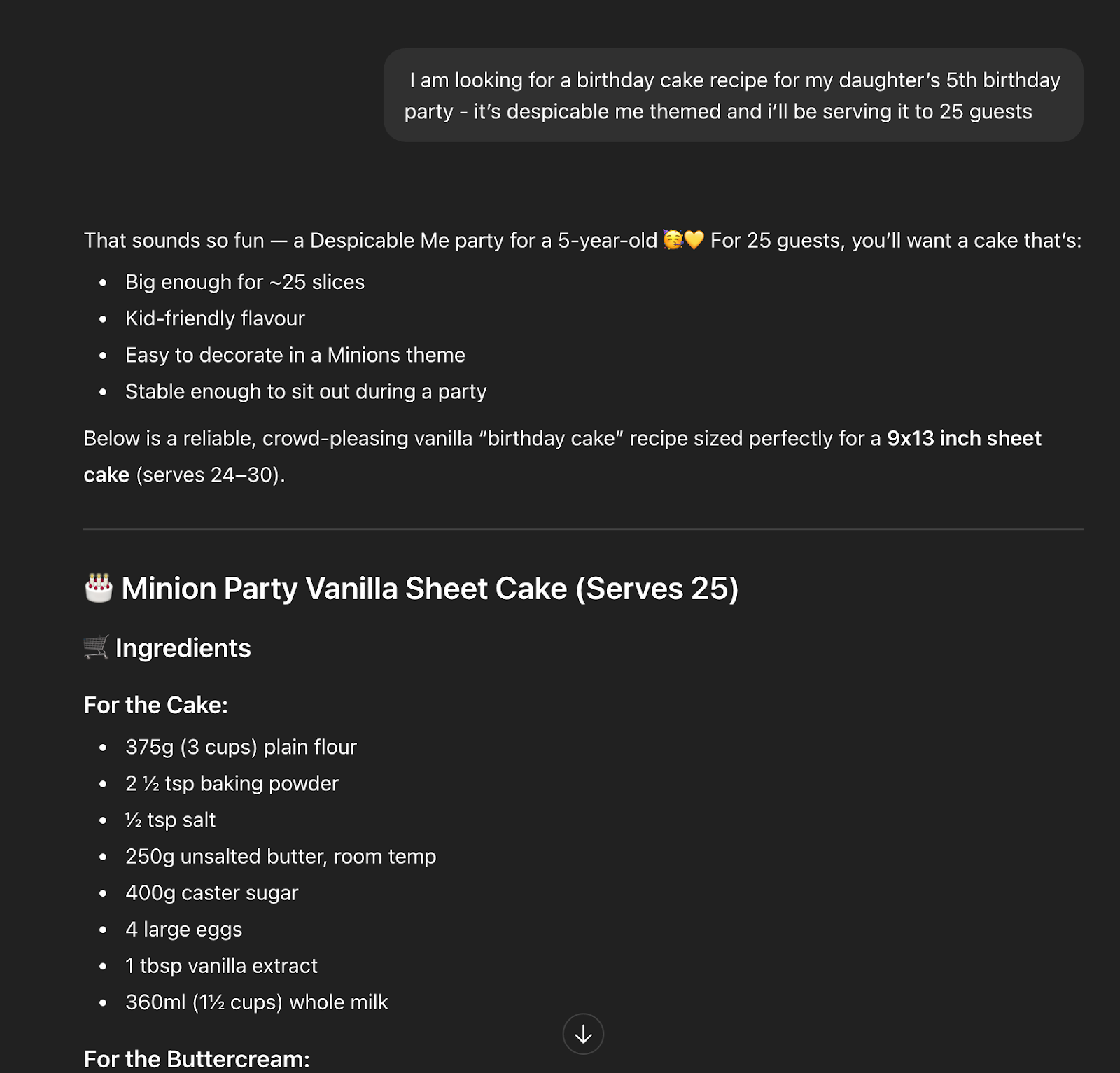
Second, user behaviour is changing. Whether it’s ChatGPT, Gemini, or Google AIO, audiences are searching in conversations rather than keywords.
What started with Gen Z and millennials as the early adopters of AI has now become mainstream. Research from GWI shows Gen Z are significantly more likely to use AI tools for discovery and research² - and older generations are rapidly adopting similar behaviours.
Their searches on AI are now hyper-personalised, intent-led and all around meeting a specific desire/want/pain point/need.
Informational queries that looked like this:
Birthday cake recipe
Now look like this:
I am looking for a birthday cake recipe for my daughter’s 5th birthday party - it’s despicable me themed and i’ll be serving it to 25 guests
Commercial queries that looked like this:
running trainers
Now look like this:
I am running my first marathon in 6 months, what trainers should I buy?
The shift is happening.
And while keyword-style searching still exists, it’s declining, So we need to be futureproofing our content strategies to be going where this is headed - not where it was.
Why has this change happened?
So, why this change? And why has it SO quickly become the norm?
The answer’s simple: Reduced friction
For the informational query:
- No more scrolling through a range of options on a Google SERP, clicking and bouncing till they find the recipe they like
- No need to actively avoid a bunch of ads that don’t really meet what you are after but take top spot because they’re paid
- And even better, no more scrolling past the dreaded author's life story before actually getting to the recipe!
- And no need to manually multiply measurements to meet their needs
Instead they’re:
- Taken straight to a recipe that matches exactly what they’re after
- The measurements have been adjusted to meet their requirements
- The ability to follow up conversationally means they can further tailor the response to their needs
For the commercial query
- No more scrolling through hundreds of running shoes across different retailers
- No need to bounce from informational article, to commercial PLP - feeling overwhelmed and unsure
- They don’t have to manually dig around and do a load of research themselves
No friction. They’re going from a click journey to answer delivery.
What this means for us
If your strategy is still focussed on the organic ranking position of keywords, you’ll notice
- Traffic from those positions decreasing
- SEO driving less revenue than before
- Your brand is getting lost in the noise of busy SERPS
Now, I’m not saying keywords shouldn’t be a key part of the strategy, but ranking positions for keywords should not be the key measurement of success in 2026.
What you should be doing
Optimising for intent
The intent should be the heart of your content, it should be what your content is built around.
- Content should reflect a clear understanding of the audience and their pain points/wants/needs/desires, and should directly address these
- This means not being scared of zero volume terms/queries if they perfectly meet the intent of your audience
- Looking at conversations across platforms and optimising your pages to reflect them
- Detailed SERP analysis and optimisation for SERP features that show up in your keyword universe
- Your content should be structured around structured, digestible answers
- Topical authority is still as important as ever - combining on-site with off-site signals
Reporting differently
Searchable platforms look different, user behaviour is different - you probably need to look at the way you report too.
- This means looking at average page rank, rather than specific keywords only to encapsulate the variety of long tail and personalised queries
- Spending less time on the number of impressions and more the value of those impressions (IE has CTR increased as a result - indicating users that are further down the funnel or that we are better hitting their intent)
- It means measuring revenue (something that can be scary to some SEO’s) as well as things like CVR and LTV.
- It means reporting on AI/LLM visibility – these platforms are much more likely to cite your content if it aligns with that specific need, answers it clearly, and demonstrates genuine expertise.
Meeting users with a more niche page that meets their specific needs usually means less people are going to be seeing the page - but it’s highly likely that once this piece is in front of the right audience, they are much more likely to click and come on that journey with you
The uncomfortable truth
Now, here’s the bad news you might see when making this shift, some of which you will be seeing anyway due to the changes on SERP.
Traffic may decrease.
Impressions may inflate while clicks consolidate.
Broad visibility will shrink.
But the value of the traffic that remains will increase.
Because, instead of capturing passive browsers, you’ll be capturing high-intent users whose needs are already clearly defined.
This means CTR, CVR and LTV should increase, and that’s where revenue lives.
And, it is these KPIs that should have always been the focus of our SEO efforts, as opposed to traffic for the sake of traffic.
Final thoughts
In 2026 we’ve moved from optimising for words to optimising for intent.
From ranking for keywords to earning a place in conversations.
And in 2026, visibility won’t belong to the loudest - it will belong to the most relevant.
Sources:
https://www.semrush.com/blog/semrush-ai-overviews-study/
https://writesonic.com/blog/consumer-search-habits
https://www.theverge.com/news/868497/google-ai-search-follow-up-questions-gemini-3
Frequently Asked Questions
.avif)