.avif)
.jpg)
TL;DR
- Search has moved from a platform (Google) to a behaviour that happens everywhere
- Preference is built before anyone reaches Google - on TikTok, Reddit, Pinterest and in AI chats
- The SEO of tomorrow uses search data to shape the whole marketing team's work - so it's now even closer to traditional marketing
- The SEO of tomorrow will be a role people dream about
Confession time…
I never dreamed of being an SEO.
In fact, back when I was studying marketing, I didn't really know what an SEO was. And I think, like most of us, I kind of just… fell into it? (Be honest - did you accidentally land in SEO too?)
What I actually dreamed of was being a marketer. I was reading books like This Is Marketing by Seth Godin, going to summits that covered every corner of marketing, and pulling apart integrated campaigns across out-of-home, social and the content on brands' websites.
So when I landed my first 'grown-up' job in content, I was absolutely buzzing. I couldn't wait to flex my creativity and take audiences on a journey.
I was going to be:
- Telling stories
- Connecting with and serving audiences
- Solving their friction
- Making them feel something about a brand
(Or if you're more technically minded, maybe it was building things and solving problems that got you excited.)
But once I started, a lot of that got lost. Instead, the job became optimising for keywords. Gamifying algorithms. Executing tactics. Reading case law. All for that 1% gain.
I was hired to tell stories through content, and suddenly I was over-optimising everything.
So in this post, I want to take you on a little journey: how SEO used to look (the job we all trained for), how search has changed and where people actually discover, research and decide today, how to become the SEO of tomorrow so you don't get left behind - and why that version of the job is the one you got into marketing for in the first place.
But first, does this set-up look familiar?
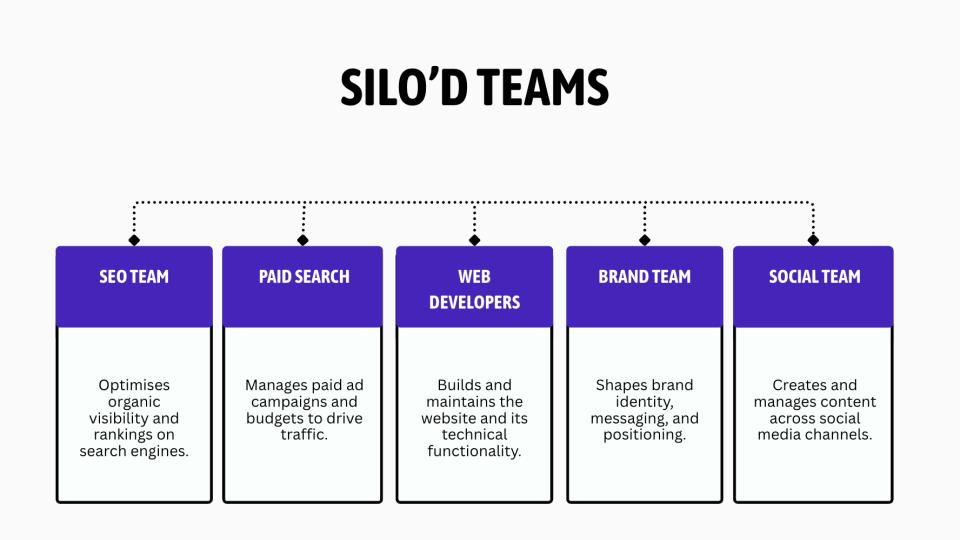
- SEO team: optimises organic visibility and rankings
- Paid search: manages ad budgets to drive traffic
- Web developers: build and maintain the site
- Brand team: shapes identity, messaging and positioning
- Social team: creates content for social channels
All working side by side, but not really together.
And SEO? We were always that team nobody quite understood. Kind of in the marketing department. Kind of not.
Search has changed
Let's get the numbers out of the way:
- Around 76% of consumers have used social media to search for or discover products, brands and experiences (TINT)
- 37% of consumers now start their searches with AI instead of Google (Search Engine Land)
- 89% of buyers research across at least three platforms before they purchase (McKinsey)
But you don't really need the stats - just think about how you search.
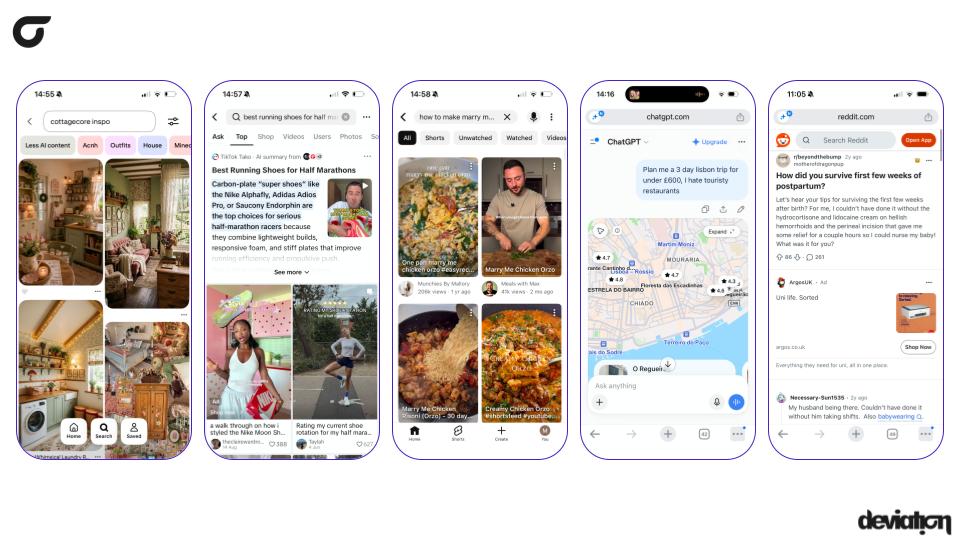
Looking for cottagecore inspo? You're on Pinterest, met with a gorgeous wall of home ideas.
Hunting for the best running shoes for a half marathon? TikTok gives you an AI summary at the top, plus real creators showing their genuine experiences.
Trying to decide what's for dinner on the train home? You're watching someone whip up marry me chicken orzo on YouTube.
After postpartum advice? You're probably heading to Mumsnet or Reddit, because the last thing you want is factual advice from Google - you want real experiences from people you can relate to.
And planning a trip to Lisbon? Instead of typing 'things to do in Lisbon', you're giving ChatGPT a detailed, personalised prompt (3 days, under £600, no touristy restaurants please).
Search used to be a platform: Google.
Now, search is a behaviour.
So why are people moving away from Google for discovery?
The answer's simple: friction.
Take those running shoes. Search 'best running shoes for half marathon' on Google and the non-brand results are, honestly, overwhelming. You scroll past a load of sponsored products, then an AI overview, then more features, and even when you finally land on an article, you can never be sure the shoes were actually tried and tested. None of it brings you any closer to making a decision you feel happy with.
Or that recipe you were after? You've only got to scroll past someone's life story first. The marry me chicken orzo one I tried took me 35 swipes. Yikes.
Social and AI platforms answer the exact same questions, but with speed, authenticity and entertainment. They remove the friction and give you more - they literally light up your brain.
So yes, search has changed. And in a way, it feels like we're all in the trenches together right now.
But here's the thing: in another way, search is going back to its roots. It's getting closer to what marketing actually is.
So we shouldn't be fearing the change. We should be embracing it.
How SEO used to work vs. how search works today
Here's the model we all trained on:
- Active search: head to Google
- Scroll and investigate
- Choose (usually from whatever ranked near the top, because we trusted what Google put in front of us)
- Purchase
Nice and neat. But is that really how we discover today? Let me tell you about my canicross journey…
One evening, a canicross video popped up on my TikTok For You page. Why was it there? Because the algorithm knows me - my previous searches, what I watch, everything I've done on the platform before. And that one video pulled me into a whole search journey. It literally made me go and search. (Demand generation in action, people!)
So I searched 'canicross' on TikTok to see more. I messaged a friend: “I'm thinking about starting canicross with the dog, I reckon she'd love it.” I asked ChatGPT whether it's hard to start canicross as an experienced runner with a one-year-old Vizsla. I went to Reddit to find out where real people in the UK buy their starter kits. I watched a DogFit video walking through exactly what's in their kit.
And then - only then - did I go to Google, search 'DogFit canicross starter kit', and buy.
(Anyway, here's my dog in her canicross gear on one of our runs. Had to.)

The point is, discovery happens before Google and today, search and discovery looks a lot more like this:
- Discover a product or pain point through passive scrolling
- Take it to social search and forums for real community experiences
- Chat with AI to explore further
- Google search
- Purchase
But - and it's a big but - it's not linear. People jump around, double back and drop off. And even if they don't buy, they're retargeted through social algorithms and paid ads (we've noticed paid works more efficiently this way too).
Those middle steps - social search, forums and AI - are where preference is built. The choice is being made before Google (Search Engine Land), so that's exactly where we should be influencing it.
SEOs are the key to unlocking brand preference
Quick definition. Preference (noun): a greater liking for one alternative over another or others.
Think of the way you'll always reach for one particular cola, even when there's another one right next to it.
And here's the bit I want you to really take in: as an SEO, you are the key to unlocking that preference for your brand.
At Deviation, we think of it like this:
Preference = Authority + Trust + Relevance
It's earned where those three meet - not through simple visibility. And our role isn't just to generate preference, but to capture it and convert it too. To do that, we need to understand the heart of every search.
Which means that to win in search today and build preference, we get to go back to the fundamentals of marketing. Only now, we do it through search:
- Telling stories through organic content
- Connecting with and serving audiences at the right time, on the right platform, for the right query
- Solving their friction by understanding their queries, pains, needs, wants and desires
- Making them feel something about a brand through authority, trust and relevance
It's everything I was dreaming about doing as a marketing student. 👀
So what does the SEO of tomorrow actually do?
The SEO of tomorrow understands how search lives across platforms - Pinterest, TikTok, YouTube, Reddit, ChatGPT and, yes, Google too. They use search data to inform campaigns across the whole business. And they've moved from optimising for keywords to understanding intent and owning conversations.
You might be thinking - but Maaria, my business is set up in a really traditional way, I can't just start doing social search tomorrow?
Totally fair. But you don't have to start on social at all, because social conversations even make it onto the SERPs.
For example, while I was at a leading gymwear brand, we noticed our audience using the term 'pump cover' on social. If you'd searched it on Google back then, you'd have been met with a SERP full of… pond pump covers. Definitely not what our audience was after!
So we created an optimised PLP that spoke to the social trend, got first-mover advantage straight to the top of the SERPs, and it became one of our best-performing PLPs.
That meant ignoring what the SERPs were telling us and pushing search volume to the side (two things SEOs can be scared of!). But it worked, and it's a brilliant way to start breaking down silos.
Because here's the thing: as an SEO, you can set the foundations for the entire marketing team.
What this looks like in practice: BullyBillows
Let me show you how this works with BullyBillows, one of the UK's leading premium dog accessory brands.
1. Start with understanding your audience
As SEOs, we have access to really rich audience data, so that's where I started for our key product focus areas. Looking at dog harnesses, I glanced at the demographics - but what I was really interested in was the rich stuff. Which YouTube channels do they spend time on? Which podcasts do they listen to? Which search platforms do they use, which websites do they buy from, and what are their highest-affinity keywords?
Before creating a single piece of content, I had a really strong understanding of who we were talking to.
2. Scope the size of the opportunity
For 'dog harness', I could see exactly what the demand looked like - around 22k searches a month in the UK - how that compares to other dog products, and how competitive the space is.
But (and this is the good bit) I could also see which platforms those searches are actually happening on.
3. Find content gaps and emerging trends
Drilling deeper into the harness category uncovered new opportunities to optimise for, like the no pull harness. I could also spot new and emerging trends, like dog paw protectors, which recently peaked (most likely thanks to the heatwave).
4. Understand the intent behind the search
I'm not only looking at the keyword - I get to truly understand it. What's the intent behind that search? What are people really experiencing?
For dog harnesses, it came down to leash control and pulling, sizing, shoulder restriction, escape risk, comfort and durability. So the content we create shows up for both the keyword and the intent.
5. See which queries and pages make money 🤑
Search data shows you exactly which terms and pages are driving revenue, so you know where to double down.
6. Put it to work everywhere
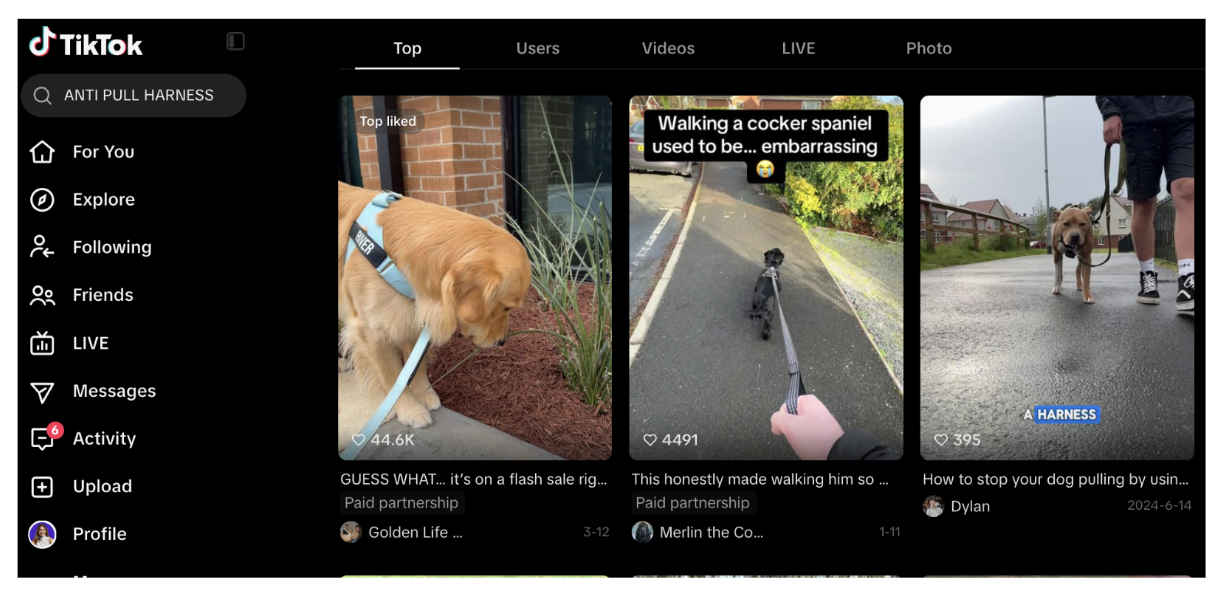
This is where it gets fun. We used that research to:
- Own traditional SERPs with intent-rich content that understands the audience (hello, no-pull harness page)
- Rank for the same queries on social platforms, like TikTok searches for 'anti pull harness'
- Rank on traditional SERPs through SERP features too, like the short videos carousel for 'dog harness for dachshund' - making our content work even harder
- Inform the entire marketing team, so the insights get used across channels (like the 'Tailored for Dachshunds' breed page)
7. Even… create new products?
Yep, really. We identified a developing social media trend that was also driving traditional searches: AirTag dog collars. The brand went away and developed the product, and it's made them extra thousands so far that they wouldn't have made otherwise.
The bottom line
Understanding your audience. Telling stories. Solving friction. Showing up where people actually are. It's all just good marketing.
Which is why I truly believe the SEO of tomorrow is the best marketer in the room. It's time to get excited again, and go back to our roots as marketers.
I never dreamed of being an SEO. But the SEO of tomorrow? That is a dream job.
What can you do on Monday?
You don't need a huge restructure to start. Try these:
- Find one conversation with peaking search on a social platform. Just one!
- Optimise a PLP for it, using both keywords and intent.
- Start chatting with your social team. Understand their priorities, and how search data can support them.
Frequently Asked Questions
What does the SEO of tomorrow actually do?
The SEO of tomorrow understands how search lives across platforms - Pinterest, TikTok, YouTube, Reddit, ChatGPT and Google. They use search data to inform campaigns across the whole business, and have moved from optimising for keywords to understanding intent and owning conversations.
Why are people moving away from Google for discovery?
Friction. Google results for many queries are crowded with sponsored products, AI overviews and SERP features, and it's hard to tell whether content is genuinely tried and tested. Social and AI platforms answer the same questions with more speed, authenticity and entertainment.
Where is brand preference built today?
Mostly before Google. Social search, forums and AI chats are where people gather real experiences and explore options, so the choice is often made before the final Google search and purchase.
How can I start becoming the SEO of tomorrow if my business is set up traditionally?
You don't need a restructure. Find one conversation with peaking search on a social platform, optimise a PLP for it using both keywords and intent, and start talking to your social team about their priorities and how search data can support them.
.avif)