.avif)

The Wrong Question
If you are asking your search team, or you are a search marketer constantly being asked questions like,
“What’s the search volume for this on ChatGPT”
you are asking the wrong question.
Now, it's not a bad instinct, it's the historical measure we have used, I get it. But the direction of travel for search in 2026 means it's just the wrong unit.
So, we are starting to see that audiences, potentially your customers, are asking AI assistants, scrolling TikTok, reading Reddit threads before they ever head to a Google interface to type a query. When you recognise this, it's only natural to ask “well what is the volume over there?”.
But, the honest answer here is that the number you want… it doesn’t exist. And what's worse, the numbers being sold to you, they fill the gap (sure!) but they may be steering your budget in the wrong direction.
MSV was always a proxy
MSV worked because Google trained your audiences to search in a predictable way.
Short phrases, typed again and again by millions of people: "best CRM", "cheap flights London", "running shoes". Repetition made demand countable.
But even on Google, MSV was never as precise as it looked in a spreadsheet:
• It's rounded and bucketed. Most figures come from ad-planning tools that group terms into ranges, then get modelled by third-party tools.
• It ignores the long tail. Many of the searches that actually convert are logged as "zero volume" because they're too specific to count.
• It measures typing, not intent. Two keywords with the same volume can mean wildly different things for your pipeline.
We accepted those flaws because MSV was good enough for a system built on repeated, shorter queries. But vitally, that system is no longer the only place where demand shows up.
AI and Social-Search break the MSV metric
AI search doesn’t share this repetition at the query level.
Your audience is not prompting AI surfaces in the same way they did a Google SERP. Nobody asks ChatGPT for
‘Best Running Shoes’
This search term is being replaced with a hyper-personalised prompt, something like
“I'm training for my first marathon, I overpronate, I run on roads three times a week and my knees ache after 10k. What should I look at, and is it worth spending over £150?”
And when they do, they already have follow up questions ready to explore further.
Every one of those conversations is unique. There's no head term to add up, because the prompt is the long tail. Asking for its monthly volume is like asking how many times a month people have the exact same conversation with their accountant.
Social Search isn't always tracked as 'search'
On TikTok, Instagram and YouTube, much of what people discover is served to them by the feed. They didn't type anything. Now, this doesn’t mean the content consumed doesn’t carry search intent, it's just that the platform doesn’t categorise a search - as the content is discovered via an FYP days after a search has taken place. We call this ‘Intent raised once, replayed back to you.
To learn more about how the FYP is a SERP you can check out the YouTube video from Ashley Liddell’s talk at Brighton SEO on this phenomenon below:
Instead, The search bar captures a slice of demand; the algorithm decides the rest. A search-volume figure for TikTok measures the slice and misses the thing that actually drives discovery.
Social search isn't mostly search.
So, the decision has moved upstream. By the time someone types your category into Google, they've often already formed a shortlist from an AI answer, a creator video and a Reddit thread. SO, MSV in 2026… it measures the last step of a journey that was largely decided elsewhere.
The Risk?
As AI assistants entered the market, and there were signs that audiences had started to embrace them for search, an array of tools claimed the solution, offering ‘AI Prompt Volumes’, tracking and more. Despite personal reservations with these tools and their claims, some can be useful for spotting direction. However, most really are modelled from small panels, synthetic prompts and obvious financial constraints in tracking. Why then, are these tools presented with the same confidence as a traditional MSV report?
That, for me at least, is a real danger. A precise-looking number in a broad deck, getting treated as fact by those leveraging the report. The budget suddenly flows to the topics that are the easiest to count - not the ones your audience and potential customers care about most.
It becomes a weird situation where a search team is optimising for the measurement, instead of the market.
For me, being roughly right about a real conversation is worth more than being precisely wrong about a flawed metric.
Start with better questions
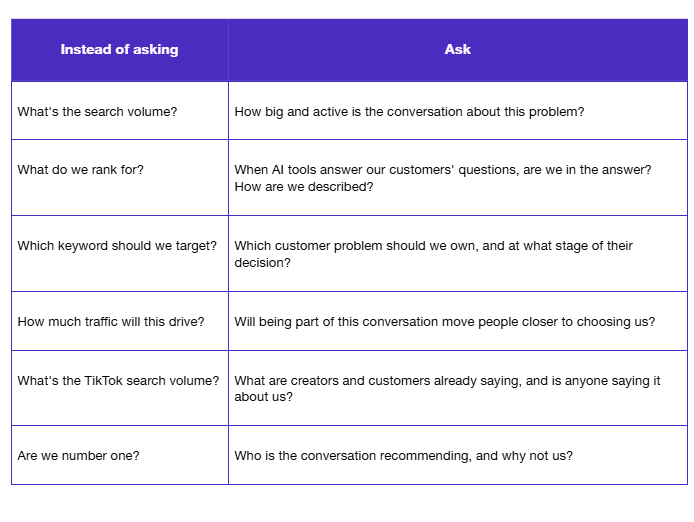
Measure the conversation, not the query
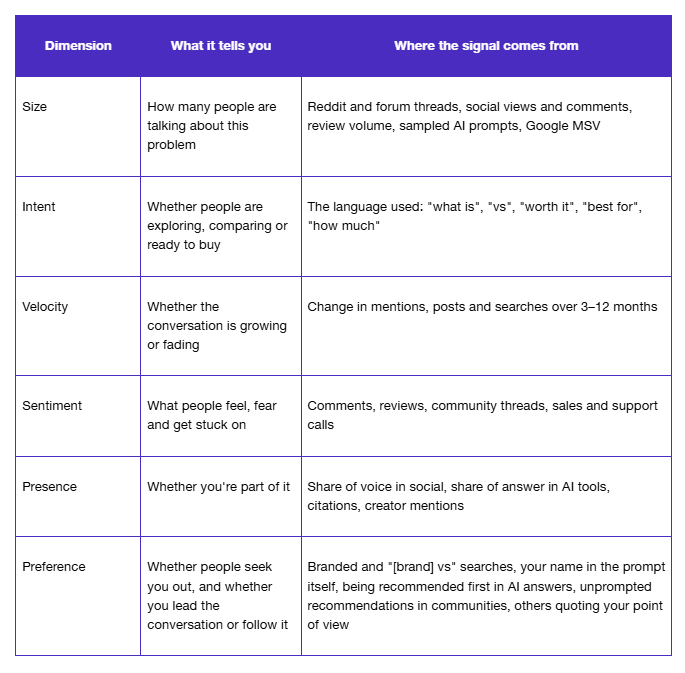
At Deviation, we consider the demand of the conversation overall, developing a way to judge a topic based on the surrounding conversation, not by how often a specific phrase gets types - we score each topic on six things.
%401x.png)
Our thinking here is that no single score replaces MSV. The point is to see the whole conversation before deciding where to show up. And showing up is only step five: the brands that win are the ones people ask for by name, and the ones setting the agenda that everyone else responds to. A topic with modest search volume but a fast-growing, high-intent conversation where you're absent is often your best opportunity.
Let's explore this
We’ve started with developing this framework for social-search. Our Search Everywhere® Index maps the conversations inside a category using real TikTok and YouTube search results, not estimates. Each topic is split into ten conversations, built from more than 450 search terms, and refreshed every quarter.
For every conversation, it shows how big the audience is, how much new content is competing for it, how long that content stays relevant and which brands are already there.
That covers Size, Velocity and Presence on the scorecard. It also surfaces openings: big audiences with little content serving them. Those are where a brand can move from present to preferred.
Let’s explore ‘running shoes’ as a topic of conversation.
Take shoe care and lifespan: how to clean running shoes, how to lace them and, above all, how long they last.

On YouTube it’s the biggest conversation in the topic, with 1.2 billion views across 2,268 videos, and only 27 of those videos come from brands. On TikTok it draws 345 million views, and brands posted just 10 of its 1,365 videos. It also has the least new content competing for it on both platforms: just 20% of YouTube videos and 25% of TikTok videos were posted recently.
That’s a big audience, asking practical questions, that almost no brand is answering.
On Google, “how to clean trainers” gets around 1.3K MSV in the UK (Semrush, October 2026).
A volume-led plan would rank it as a minor keyword and move on. On social media, the same conversation has drawn more than 1.5 billion views across TikTok and YouTube, and a typical video earns over 10,000 views on its own.
***The index currently covers beauty, fashion and travel, and it measures social only. AI search needs its own read, which is where the rest of the scorecard becomes useful for your team.
Where MSV should belong
This isn't a eulogy for search volume.
Google still drives a large share of demand, and MSV remains a useful signal for classic search. It's quick, it's comparable and it shows broad direction.
The change is in its job. MSV moves from the deciding factor to one input among several.
It answers "how often is this typed into Google?" It no longer answers "how much does this matter to our customers?"
And yes, conversation signals are messier. They're harder to benchmark and harder to put in a single cell. That's the trade: a less tidy number that describes how people actually decide.
What to do to get started on Monday
1. Pick our five most important customer problems. How big is the conversation about each one, across search, AI and social?
2. Ask an AI assistant the questions our customers ask. Are we mentioned? Is what it says accurate?
3. Which conversations are growing fastest, and are we absent from any of them? Where we are present, do people ask for us by name, or are we just one of the options?
4. Which "zero-volume" topics have actually driven the pipeline for us?
5. What would we stop funding if volume weren't the deciding factor?
Your customers stopped thinking in keywords a while ago. They think in questions, problems and conversations. The brands that win the next few years will be the ones that measure demand the same way.
So the next time a dashboard offers you a search volume for an AI assistant, ask a better question:
What are people actually talking about, and are we part of it? If you want to see the answer for your category, start with the Search Everywhere® Index.
Frequently Asked Questions
Is monthly search volume still worth tracking?
Yes, for classic Google search. It's quick, comparable and good for spotting broad direction. It just shouldn't be the deciding factor on its own, because it only shows how often a phrase is typed into Google, not how much a topic matters to your customers.
Can you measure search volume for ChatGPT or other AI tools?
Not reliably. AI prompts are long, personal and rarely repeated word for word, so there's no head term to count. Tools that report "prompt volume" mostly model it from small panels or synthetic prompts. Treat those figures as directional at best, and test the real questions your customers ask to see whether you appear in the answer.
How do you measure the size of a conversation?
Combine signals rather than relying on one number: forum and Reddit threads, social views and comments, review volume, sampled AI prompts and Google search volume. Then look at whether the conversation is growing or fading. For TikTok and YouTube, the Search Everywhere® Index maps this from real search results.
What's the difference between presence and preference?
Presence means you're part of the conversation: you're mentioned, cited or included in the answer. Preference means you lead it: people ask for you by name, AI tools recommend you first and others quote your point of view. Presence gets you considered; preference gets you chosen.
.avif)