.avif)

For as long as most marketers (especially SEOs) can remember, Google Search Console has only spoken one language: your website.
It could tell you exactly which queries sent people to your blog post, but the moment your content lived on Instagram, TikTok, X, or YouTube instead, you were flying blind.
Platform-native analytics could tell you what happened on a post, but never why, never which search term actually put it in front of someone.
That gap just closed.
On July 7, 2026, Google announced platform properties, a new property type inside Search Console built specifically for social and video accounts. If you post content anywhere other than your own domain, this is worth five minutes of your attention.
So what actually is a platform property?
Think of it as a Search Console property, but instead of verifying a domain, you verify a social or video account. Once connected, Google shows you the same kind of search performance data it has always given website owners.
Think: clicks, impressions, and the queries behind them.
Except now, it’s not for your domain, it's tied to your Instagram grid, your TikTok profile, or your YouTube channel.
Crucially, you don't need a website to use it. That's a deliberate design choice: this is aimed just as much at creators whose entire presence lives on social platforms as it is at brands managing a mix of owned and earned channels.
The three reports you'll actually use
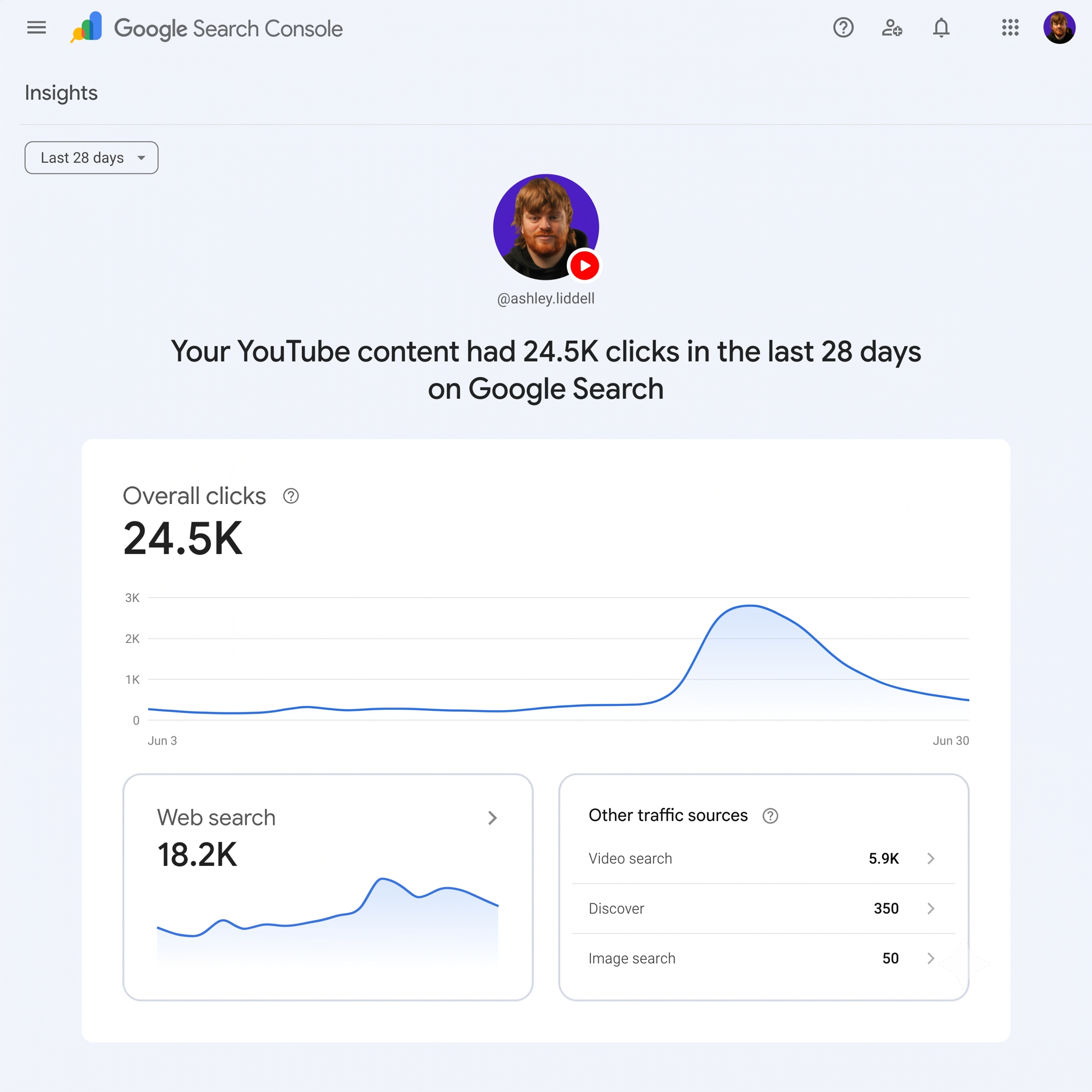
Each platform property comes with the same reporting shape Search Console veterans will recognize:
- Performance: total clicks and impressions, filterable by individual post or query, with export options if you want to pull the data into another dashboard.
- Insights: a higher-level summary of recent traffic trends, your top-performing posts, and how people are discovering your account through Google in the first place (As shown in the image above).
- Achievements: milestone tracking, like crossing a new total-click threshold over a rolling 28-day window. More of a motivational nudge than a strategic lever, but a nice thing to screenshot for a client update.
Who's supported, and who isn't (yet)
At launch, four platforms are eligible: Instagram, TikTok, X, and YouTube. Facebook and LinkedIn are notably absent. That's not necessarily a permanent decision, it comes down to whether Google has struck the right API and verification agreements with each platform to safely confirm you actually own the account before handing over its search data. LinkedIn in particular has historically guarded its data more closely, so B2B-heavy teams may be waiting a while longer.
Getting set up
The rollout is gradual, so don't panic if you don't see it yet. When it arrives, setup is simple:
- Open Search Console.
- Open the property selector and choose ‘Add property’.
- Select Instagram, TikTok, X, or YouTube.
- Follow the prompts to authorise the connection.
One important catch: there's no backfill. Data collection starts the moment you verify the property, not retroactively. If you want a meaningful baseline, the move is to connect your accounts ASAP, rather than waiting until you have a specific question to answer.
How this differs from what came before
Two things worth untangling here. First, this isn't the same as Search profiles, which Google shipped back in June. Those are public, shareable pages that showcase a creator's content to an audience. Platform properties are the opposite: private, internal analytics for your own eyes.
Second, this isn't entirely from scratch either. It builds on a smaller December 2025 experiment that surfaced limited social channel data inside Search Console Insights.
Platform properties are that idea, generalized and given proper first-class reporting.
Why this matters more than it looks
On the surface, this reads like a minor feature addition. In practice, it quietly resolves a long-running measurement problem: social performance and search performance have lived in completely separate worlds, with social teams staring at in-app analytics and SEO teams staring at Search Console, each side only seeing half the picture.
That separation mattered because Google has been indexing and surfacing social and video content in Search and Discover for a while now, regardless of whether anyone was tracking it there. A TikTok video could be quietly earning impressions through Google Search with nobody the wiser.
Now that visibility exists, the same questions you'd ask about a webpage, IE: what are people actually searching for, and does this content answer it, well… they apply just as directly to a Reel or a YouTube upload.
Why this matters if you're a creator
If you're a creator rather than a brand, this update deserves a closer look than it might get at first glance, because it changes the kind of evidence you can put in front of a potential partner.
Right now, most creator pitches lean on platform-native numbers: followers, views, engagement rate, maybe a screenshot of a particularly good week. That's useful, but it's also a number every brand has seen a thousand times, and it says nothing about intent.
A view doesn't tell a brand whether someone found you by accident scrolling a feed, or because they actively searched for something and your content was the answer.
Platform properties give you a different kind of proof. If you can show that a post is showing up for real search queries on Google, and pulling in clicks and impressions off the back of that, you're no longer just saying "people watch my content."
You're saying "my content ranks." That's a meaningfully different claim… It's the difference between an audience that finds you and an audience that is actively looking for what you make, matched against specific, visible search terms.
For brand partnerships, that distinction matters a lot:
- It reframes you as a discovery channel, not just a reach channel. A brand isn't only buying attention from your existing followers; they're buying a chance to be found by everyone searching around a topic you already rank for.
- It gives you queries, not just categories. Instead of pitching yourself as "a fitness creator," you can point to the exact searches, say, "at-home shoulder mobility routine", that are already sending clicks to your content. That's a much easier thing for a brand to map against their own goals.
- It's evidence a brand's own team can verify the logic of. Marketers already understand what clicks and impressions on a SERP mean, because it's the same language their SEO and paid search teams use internally. You're not asking them to trust a new metric; you're handing them one they already know how to evaluate.
- It supports better-aligned deals, not just bigger ones. A brand selling hiking gear cares less about your total follower count and more about whether you're actually visible against the searches their customers are already typing. Data like this makes it possible to pitch (and more effectively price) a partnership based on relevance, rather than raw audience size.
None of this replaces the usual creator metrics, and it won't be the deciding factor in every deal. But it adds a layer of proof that's been almost entirely missing from creator-brand conversations up to this point: independent, Google-verified evidence that your content is being actively searched for and clicked on, not just passively consumed.
For creators willing to build a habit of checking this data and pulling the strongest examples into a media kit, it's a genuinely new argument to bring to the table, and one a brand's own team will find hard to dismiss, because it's speaking their language.
An example:
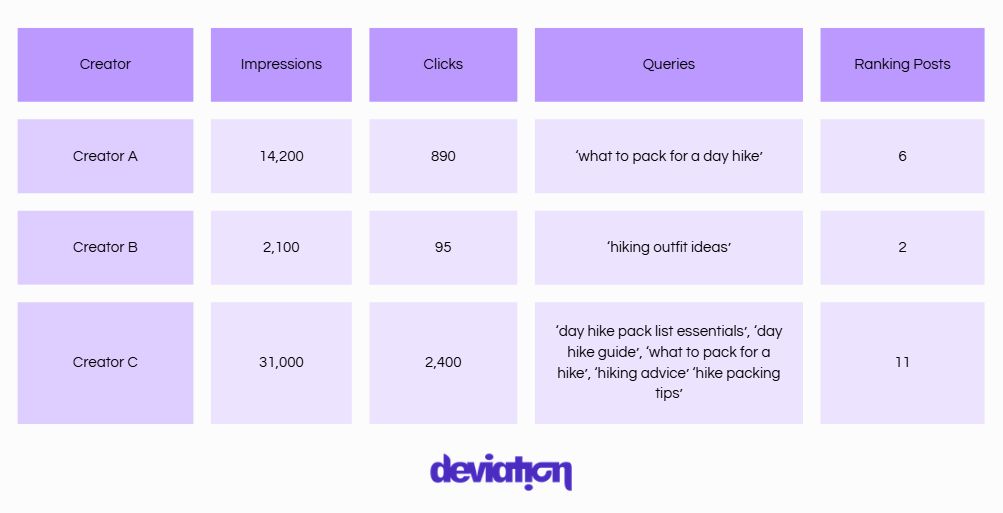
Deviation (working with ThruDark on our latest campaign for ‘hiking content’) wants creators for a "what to pack for a day hike" campaign. Instead of judging completely based on follower count, we could now shift, asking each prospective creator to pull their platform property data filtered to hiking/packing queries over the last 6 months.
What comes back:
Next steps?
Well, ‘Creator A’ and ‘Creator C’ both show sustained, repeated visibility specifically in the packing conversation, not just hiking more broadly. ‘Creator C’s 11 ranking posts signal a pattern, not a one-off viral hit. ‘Creator B’ is a fine creator, just anchored in a different pillar (outfits, not gear)... meaning they are probably better suited to a different brief.
The decision:
Deviation shortlists A and C for this campaign specifically, because they have verifiable search history in the exact conversation the campaign is built around — not a guess based on vibe or reach.
Why it's better than the old approach:
It replaces "we think this creator's audience cares about packing lists" with "this creator has ranked for packing-list searches 11 times in six months." For creators, the takeaway is simple: track your platform property data by topic/pillar, not just overall totals, that's what lets you answer a request like this in minutes, not days.
See it on your own data
Constellation (Our new prototype tool) turns your Google Search Console export into plain-English content pillars for your next brand pitch - for no cost, in your browser, no data ever stored by Deviation - Find out which conversations you participate you in, and which you own already!
What to actually do this week
Don't overthink the first move.
Check whether platform properties have appeared in your Search Console account yet, and if they have, connect whatever accounts you're actively posting to (or the ones you intend to utilise actively in the future - even before you have a specific analysis in mind.
Since there's no historical backfill, every week you wait is a week of query data you'll never get back. Once you've got two or three weeks of Performance and Insights data sitting there, you'll have a far clearer answer than any guesswork about which of your social posts are genuinely earning visibility through Google, rather than just algorithmic reach inside the app itself.
Stop guessing which topics are yours.
Everything above is easier to act on when you can see it on your own numbers.
Constellation (A prototype by Deviation) reads your Google Search Console export and hands you back a clean set of content pillars, the plain-English version brands actually respond to. Free, runs in your browser, and nothing you upload is ever stored by Deviation.
Find out which conversations you participate you in, and which you own already!
Not ready to export? There's a live sample inside — poke around first.
Frequently Asked Questions
What are platform properties in Google Search Console?
Platform properties are a new property type in Search Console, launched July 7, 2026, that let creators and brands track how their content on social and video platforms — Instagram, TikTok, X, and YouTube at launch — performs in Google Search and Discover. Rather than verifying a website domain, you verify a social or video account, and Search Console then shows you the same kind of data it's always offered for websites: clicks, impressions, and the specific search queries leading people to your posts. It's designed to close a long-standing gap, since social content has been discoverable through Google for years, but there was previously no way to see the search performance behind it.
Will I be able to see historical data once I connect my account?
No. There's no backfill — data collection starts from the moment you verify the property, so it's worth connecting your accounts sooner rather than waiting.
Why isn't LinkedIn or Facebook included yet?
Likely due to API access and data-sharing agreements between Google and each platform. LinkedIn in particular has historically been more protective of its data, so B2B creators may be waiting longer.
Do I need a website to use platform properties?
No. That's one of the key differences from standard Search Console properties — platform properties work for creators whose only presence is a social or video account.
.avif)